Monday, 29 August 2011

Don't Make Me Sick

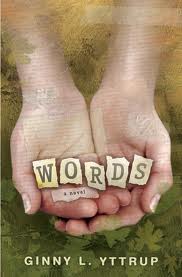
I mentioned in my last post that I was reading Words by Ginny L. Yttrup.  Don't ask me how to pronounce it.  I don't know.  But I have finished the book.  I didn't want to write about this book.  I wanted to read a book for enjoyment and not have to think and take notes. You'll wonder at my choice in a moment.  I knew I wanted to read this book before it came out.  It sounded so intriguing.  But I must admit though I had my doubts about the painful storyline.

Words is mainly told from two perspectives.  It starts with Kaylee, a ten-year old girl, abandoned by her mother and sexually abused by the boyfriend she left behind with her child.  Yeah, tough stuff.  To escape her horrible reality, she reads and collects words.  Due to the trauma she has endured, though, she stops speaking, so those words remain confined to her mind and paper.

The second perspective is Sierra's, a woman who is holding onto the pain of being responsible for the death of her baby daughter 12 years earlier.  As predicted, their lives connect and they eventually both find freedom in Christ and healing from their past.

Although the plot seemed a little far-fetched at times, I really enjoyed this book because of how the author dealt with such a painful subject.  Many books that deal with similar topics often contain graphic detail and cause your stomach to churn.  I like detail, and sometimes it's necessary, but not too much in these cases.  The most graphic details in the book were related to drug abuse.

How does an author write a book about abuse and effectively connect with the reader without being graphic?  Easy.  Tell the story from the abused child's perspective.  A child who is alone, scared, embarrassed, ashamed, and thinks it's her fault.  A child who refuses to tell anyone, or should I say, write it for anyone.  A child who wonders if she's a whore.  A child who will only elude to what's happening to her and shares with the reader how it affects her.  That tugs at the reader enough without graphic details.

In the back of the book, we also learn that the author wrote this book out of personal experience and now helps women suffering trauma from sexual abuse.  She knows.  She understand what victims suffer and makes her the perfect candidate to write such a story.

I've read some great books and I enjoy detail, but when dealing with such difficult issues, you can do without and still write a great story.  In some cases, details become necessary, but not always.  Writers can connect with me without having to make me sick.

Tuesday, 23 August 2011

Books and Random Conversations

I had an appointment to go to yesterday morning before heading to work, and as usual, I brought a book along to pass the waiting time.  This time it was a novel called Words by Ginny L. Yttrup, which I will likely write about in the near future.  I was sitting in a large waiting room, all alone, when a man walks in, pauses in front of me, as I'm focused on my book and strikes up a conversation.  "That's something you never see anymore!"

I look up and he explains how long it had been since he had seen a person, especially a young one reading a physical book in a waiting room.  Apparently tablets are becoming a lot more popular than paper.  In the 20 minutes or so that followed, I had discussions with three complete strangers about the direction of the book and music industries, e-readers, cell phones, other technology, teenagers and social etiquette.  I left feeling inspired and filled with joy that carried me through the rest of the day.

I'm amazed at the discovery I just made.  I never would have thought that something so small and seemingly insignificant could lead to something so meaningful.  The book I was reading was of no significance.  It was simply the fact that I was reading a paper book.  Maybe the fact that I was young, dressed for work and looking preppy had more to do with it.  I really don't know.  But a book for me produced an opportunity.

In 20 minutes, I had a chance to share my perspective with individuals much older than myself.  I had a chance to show them that there are teens out there who think differently than the rest of the world.  I had a chance to put a smile on their faces.  I had a chance to share what I've been learning and why I have made some of the decisions I have.  I left feeling not only inspired, but also that what I have to say really does matter.

Here's what I have to tell my readers.  The small, seemingly insignificant things you do matter, even if you'd rather use a Kindle over paper.  Your choices in all areas of life hold the power to impact.  Don't be afraid to be counter cultural. When opportunities present themselves, don't be afraid to share your perspective.  Even if you don't have a chance to share the Gospel, if they can see that your life is different, that you're not following the norm, you never know what kind of seeds you may plant and what fruit they may later produce.

Why do I read physical books?  Because I simply love a physical book.  I prefer to read off of paper than a glaring screen.  Don't get me wrong. I use my computer a lot and make use of the countless online resources available to me.  Although some people have encouraged me to purchase a Kindle, I'm not quite ready for that. Yes, the idea of being able to carry my whole library around in my purse is enticing, but I still love seeing books on a shelf.  Books are meant to be shared.  Technology has provided alternatives for so many things, and I love it, but I'm not quite ready to let go of my books.

Here are a couple of articles I wrote that I used in my conversations yesterday.  Who would have thought the ideas I ponder on my blog could prove to be so useful in everyday life?
Why I Don't Have a Cell Phone
New Trends in Education

Monday, 22 August 2011

Thinking is Hard

"Your exposure to greatness changes you: your ideas are bigger, your dreams wilder, your plans more challenging, your faith more powerful.

The classics can be hard work, and that is exactly what is needed to learn to think.  Thinking is hard; deep thinking is not entertaining or easy.  Thinking is like exercise, it requires consistency and rigor.  Like barbells in a weightlifting room, the classics force us to think.  Not just in a rote memory way, either.  The classics make us struggle, search, ponder, seek, analyze, discover, decide, and reconsider.  As with physical exercise, the exertion leads to pleasing results as we metamorphose and experience the pleasure of doing something wholesome and difficult that changes us for the better."  --Oliver De Mille, A Thomas Jefferson Education

Thursday, 18 August 2011

Boston Trip

Last week, I had the great privilege of visiting Boston and surrounding area.  It was a trip full of a lot of first experiences and jumping out of my comfort zone.  I flew, saw the ocean, and rode subways for the first time and did a host of other things.  I know that's all a little shocking, but it's true.

When I first flew in and went into the city, it was a bit of a culture shock.  Where I live, I'm very unaccustomed to city life, and here I was in a different country, a big city and trying to take in all the things around me.  It was a little overwhelming.  There's vendors on many streets selling food, drinks, produce, pastries, souvenirs and it's almost like walking through a fair or farmer's market in some areas.

The first day I was able to make a far too short visit to the Museum of Fine Arts.  Beautiful!  You don't need a lot of knowledge or interest in art to enjoy a place like that.  A little appreciation for beauty and talent will do.  I came the day after the Chihuly exhibit ended, which was unfortunate, but they still had a few of his pieces on display.  That evening I went to a singles event at a Boston church and heard a professor from Gordon Conwell Theological Seminary speak.  I wish I could have wrapped that whole talk up and taken it home with me.  I got to end the night by walking a long way through the city after dark in a torrential downpour.

I saw a lot of things in Boston, but the problem was there was so much to take in, I don't remember it all.  I did see a number of historical sites, the Freedom Trail, the City Hall, the Boston Library, a Steinway store and expensive fashion taste on Newbury Street.  I also climbed Beacon Hill and enjoyed stepping out of the busy city scene and relaxing in the Boston Common and Public Garden.  I feel like I saw a lot, but it was only a tiny portion of the city

For the remaining days of my stay I visited smaller towns in the area, which have some of the coolest shops, art galleries, taffy factories, restaurants, bakeries and more.  These are the kinds of towns I often saw in pictures, but rarely saw for myself.  I was going to bring back postcards, but couldn't find any that did the places justice. 

Last but not least, I got to spend a couple afternoons at the ocean.  The cold, clear water, sun and sand were so refreshing.  I enjoyed boogie boarding, as long as my head stayed above the water.  Salt water tastes nasty. I don't know how anybody could find that taste pleasant.  I saw a lot of jellyfish eggs on one beach, which was pretty neat. 

I even enjoyed the simple pleasure of sitting at the airport with coffee, a giant cookie and a book waiting for my flight home.  Home to heat and humidity I didn't miss at all.  But I loved coming home as well.

There's a random, brief snapshot of my vacation.  Envy me yet?

Monday, 15 August 2011

Careers and Personal Life

I don't know a whole lot about politics or American history, but you don't have to in order to know there's always rivalries.  I usually don't pay much attention to it.  I have no interest in listening to politicians bicker and insult each other.  But 10 Best Political Rivalries in American History did catch my attention.

In several cases, the individuals who were at odds with each other in the political arena had personal problems with each other first.  Burr and Hamilton hated each other and it ended violently.  Such was also the case with Brooks and Sumner.

The problems between VP Richard Nixon and Senator John F. Kennedy were also personal, but on a different level.  Nixon's sense of insecurity and inferiority caused him problems in the political arena.  Sure, he had all the credentials, but he came from a poor family whereas he viewed Kennedy as a privileged rich boy.  He didn't think he measured up. Later as president, he had to work to expose the grime in possible opponent Senator Ted Kennedy's life in the 1972 election.  His negative self image affected his political career, causing conflict that may not have been necessary.

What I mostly see in this article is that your personal life and career will always affect each other to some degree.  Politicians who couldn't get along with one another personally couldn't work well together and even caused them to turn to violence.  The way you grow up, view yourself and view others will affect your confidence in your work.  If you don't think you can make yourself look good to the public, you have to try to make someone else look bad to give yourself chance.

As much as some people would like to make a clear distinction between work and personal life, you just can't.  They'll always be at least somewhat connected.  If you lack honesty and integrity at home or in your social life, chances are you may at work as well.  If you have problems at work, you'll bring them home with you. They can never be entirely separated.  And don't think you leave your problems behind when you walk out the door.  They will follow you.

Saturday, 6 August 2011

Mikeschair - Someone Worth Dying For

I leave for a vacation next week, but this is what I leave you with in the meantime.

Sunday, 31 July 2011

The Kids' Social Club

Have you ever listened to or been part of a conversation where a parent has been considering homeschooling?  Concerned individuals of the motion usually aren't concerned about the quality of education the child will receive, although whether their education will later be valid is a good concern that will come up.  The most common question is this: How will your kids learn to socialize?

I tire of hearing this lame question.  Since when is school about socializing?  Unfortunately that's become a very important, if not the most important aspect in today's system, but it shouldn't be.  There are many reasons why parents choose to homeschool, but shouldn't the quality of their education be a primary concern, rather than their social life?

I personally spent 11 mostly miserable years in the public school system and spent two years at home studying through an individual study program.  For the most part, I don't have a lot of good school memories.  Yes, I liked learning and my grades were good, but I was always struggling to fit in.  I often felt like I was near the bottom of the pecking order and many days I just wanted to play sick.  Being smart didn't help either.  Unless you're popular, you're better off being a loser and sitting in the principal's office every week than being a "teacher's pet."  I was more than happy to leave when I did.

How will they learn to socialize?  How do children learn to socialize in public schools?  They learn to form cliques, to shun others, to bite, chew, tear down, and drive the outsiders to depression and thoughts of suicide.  Oh yes, the students listen to countless anti-bullying speeches, but they often seemed pretty fruitless.  Kids learn to stay in touch with the latest trends in our culture, to discover and experiment with drugs, talk dirty and how to have "safe sex" or not so safe. Is that really how you want them to learn to socialize?

The funny this is, as many homeschooled friends as I have, I can't say any of them are anti-social or ill-mannered.  Many of them are much more socially competent than the high school students I knew.  I'm sure there's plenty of bad homeschooled examples.  The fault lies not in the method, but in the parents.  It's up to the parents to teach their children how to socialize and conduct themselves in public.  By getting them involved in church activities, homeschool groups, sports teams, other extracurricular activities and spending time with other young families, they'll get plenty of time with kids their own age.  They don't need a school.

I like how Oliver DeMille examines this issue in A Thomas Jefferson Education.  Although it's not a book about homeschooling, it definitely favours the method over what he calls the conveyor belt method, if done properly.  And according to DeMille, socialization is a lot more than what children are learning in schools.  "The highest level of socialization, the ideal, means the ability to effectively work with people of all backgrounds, stations, and positions, of really caring for them and being able to build and maintain long term, nurturing relationships."

After 11 years on the belt, I never learned to do that.  Let's face it.  The kids' social club doesn't produce good social skills.  Stop giving me that lame objection.  You'll have to come up with something else.  And judging from how many of conversations I've heard, I already have a good idea what it is.  I don't want to hear it anymore.

Wednesday, 27 July 2011

Let's Not Talk About That

Have you ever been in a Christian meeting or study where the leader has asked if anyone has input or questions and the silence is so thick you're afraid to breathe?  It's hard to believe after what you've just heard nobody has anything to say.  Were they even listening?

They're all doing the same thing you are.  Listening to their heart pound as they turn around that one thought they wouldn't dare ever say out loud.  Everybody's afraid.  Scared about what other people will think.  Embarrassed. Ashamed.

I've noticed something as of late.  I've read or looked at books and endless resources for Christian youth and singles and there are certain issues that are evidently big problems within the church, but I have rarely, if ever, heard them spoken of in person, face to face.  Why is this?

One thing I do know is that we are all humans born with very much the same tendencies.  No problems are new, unique, or limited to certain groups of people.  But there are certain things we shrink away from, avoid and simply hope for the best. 

We all know these problems exist in the world and in the church, but we don't talk about them.  Do we simply hope that our teens or youth don't have problems with these things?  Do we think that our church or group is better than all the rest?  Are we afraid simply because it's uncomfortable and you might have to say words you nearly blush to think about?  Why do we stay quiet about certain issues? 

All people, not just young people, have questions about a whole host of subjects but everyone's afraid.  Afraid to stand out.  Afraid of what people think.  Afraid of being vulnerable.  Afraid of what would happen if anyone knew.  So we protect our questions and secrets, bind them up with chains of steel and ache alone.

I love Tenth Avenue North's song Healing Begins.  But it also often makes me uncomfortable because it's so true and frightening.  In this video journal of the song, lead singer Mike Donehey talks about how confessing something to God is easy, but having to tell someone else freaks us out.  People scare us a lot more than God does. 

The truth is though, keeping things quiet doesn't fix anything.  Knowing something you're doing is wrong doesn't fix anything.  It's only when you start talking about downright scary stuff though that people can find freedom and healing.  And nobody's ready for that.

Tuesday, 19 July 2011

Christians and Secular Books

Charles Finny once said "I cannot believe that a person who has ever known the love of God can relish a secular novel" and denounced many great writers.  I'm sure many Christians, past and present, share this view.  Charles Colson, however, provides and excellent response to that statement in his book The One Year Devotions for People of Purpose. 

Many writers of secular books weave profound Christian themes into their works, and interestingly enough, these works have brought people to Christ when the Bible didn't.  This was the case with Louise Cowan, coauthor of Invitation to the Classics.  After reading numerous theological works and the Bible, she did not return to the faith.  It was eventually the works of Shakespeare and The Brothers Karamazov  by Fyodor Dostoyevsky that allowed her to see the truth of the Gospel.  Colson shares another story of a Russian girl who was converted by reading literature when she was not allowed to read the Bible. 

Is it possible that we as Christians have put God in a box, thinking that he only speaks through His Word and His children?  Although this is very often the case, by the above stories we can also see that God works way outside of that.  He can reach the lost through the work of unbelievers, who may not have intended to bring glory to Him whatsoever.  I have found no indication that Dostoyevsky was a Christian, (although he may have been) and God used him to bring souls to Himself.

There is power in story.  I have often found that novels can teach me just as much as a book out of the Spiritual Growth section.  Jesus Himself often used parables to teach people spiritual ideas.  Louise Cowan explained how literature brought her to where she is. "Not until a literary work of art awakened my imaginative faculties could the possibility of a larger context and reason alone engage my mind. . . . I had to be transformed in the way that literature transforms--by story, image, symbol--before I could see the simple truths of the Gospel."

Don't underestimate the power of story and literary works.  They can teach us much about our world and lead others to their Creator.

Friday, 15 July 2011

You're a Genius!

"Greatness isn't the work of a few geniuses, it is the purpose of each of us.  It is why we were born.  Every person you have ever met is a genius.  Every one.  Some of us have chosen not to develop it, but it is there.  It is in us.  All of us.  It is in your spouse.  It is in each of your children.  You live in a world of geniuses.  How can we settle for anything less than the best education?  How can we tell our children that mediocre education will do, when greatness is available?" --Oliver DeMille, A Thomas Jefferson Education